Field Fiction
The Phantom Prototype
A working prototype built in one night out of infrastructure the company already owned, and the two words that killed it without ever explaining why.
The number came down from Finance the same week it always did, the week everyone in the building had learned to brace for without anyone officially announcing a season for it. Dynamics licensing, servicing module only, renewed at a figure that made Grant read it twice before he forwarded it to Tom with no comment attached, which was its own kind of comment.
“Corporate wants ten percent out of the platform line by Q3,” Grant said, once he’d called instead of just letting the email sit there. “Not asking how. Just the number.”
“Ten percent of what, exactly? We’re not going to unwind the contract by Q3. Nobody unwinds a contract like this by Q3.”
“I know. I didn’t write the memo.”
Tom let that sit, the way he let most things sit that weren’t worth arguing with the messenger over. It wasn’t really about the number, and both of them knew it. It was about the fact that the company had spent three years describing Dynamics as the future of servicing and was now, in the same breath, describing it as the thing costing too much to keep, and nobody upstream seemed bothered by holding both of those at once.
What actually kept Tom up that week wasn’t the invoice. It was Priya, from the servicing floor, cornering him near the elevators to ask, not for the first time, why the case history on her screen sometimes didn’t match what the customer was telling her, live, on the same call. “I pull up the account and it says one open case. He says he called about a second one an hour ago. I’m sitting there sounding like I don’t know my own system, because my own system doesn’t know yet either.”
Tom already knew why. Dynamics didn’t read the customer record live. It read a synced copy, refreshed on an interval nobody had ever tuned tighter than fifteen minutes, because tuning it tighter cost more, and cost was the one lever everyone upstream actually knew how to pull. An agent on a live call was working from a version of the truth that was, on a bad day, old enough to matter.
So the mandate wasn’t really one problem. It was two, stacked on top of each other and pointing the same direction: a platform too expensive to keep funding at its current shape, and too slow, in the one moment it mattered most, to be doing the job it was bought to do. Corporate wanted the first one solved. Tom couldn’t stop thinking about the second.
He didn’t pitch it as a project. Projects got a name, a backlog, a stakeholder list, and a way of dying slowly in a queue before anyone found out whether the idea itself was any good. He pitched it, instead, to exactly two people, as a question: could this actually be done with what they already had, or was he wrong about that.
Wesley didn’t need much convincing. He owned the API layer everything else in the building quietly depended on, and he’d spent enough years watching other systems route around Dynamics rather than through it that he already had opinions about what a leaner front end could reuse. “The gateway’s already exposing the account and case endpoints,” he said, before Tom had finished the sentence. “Servicing just doesn’t call them directly. It goes through Dynamics’ sync layer because that’s the only door anyone ever built for it.”
Zayn was the one Tom hadn’t been sure would say yes, and not because of skill. Skill had never once been the question with Zayn. It was that Tom already knew what a good, quietly built prototype had once cost him. Years back, on a different platform, Zayn had walked a working proof-of-concept into a room and watched a director say the word interesting and then nothing else, ever, about it again. Tom half expected him to pass on principle alone. He didn’t. “I know exactly what’s good in Dynamics,” Zayn said, in the same unhurried voice he used for almost everything. “I also know exactly what it’s duplicating that we already had somewhere else, before we ever paid for it a second time. I’d rather spend a night proving that than watch it get decided by people who’ve never opened the platform themselves.”
They picked a Thursday night, a lower environment nobody was watching, and a whiteboard nobody would ask about until Monday. Tom brought coffee. Wesley brought the gateway credentials for the sandbox tier. Zayn brought a list, longer than Tom expected, of every field the servicing floor actually looked at during a call, culled down from a platform that had grown, over years, to expose roughly four times that much.
“We’re not rebuilding Dynamics,” Tom said, mostly to himself, somewhere around midnight, watching the first screen come up clean in the sandbox. “We’re building the twelve things Priya actually uses, live, instead of the four hundred things nobody asked for on a fifteen-minute delay.”
Nobody argued with that. They just kept typing.
By four in the morning, the thing worked, and the part that unsettled Tom most wasn’t how well it worked. It was how little of it was new.
The React front end sat on an Azure App Service the team already had provisioned for a different, mostly dormant pilot, sitting inside the same virtual network Dynamics itself ran behind. No new firewall rule. No new vendor to onboard, no new procurement request to file, no new attack surface for InfoSec to discover six months from now and ask uncomfortable questions about. It talked to the same API gateway every other servicing tool in the building already talked to, over the same private tunnel, hitting the same on-prem case and account services that had been sitting there, documented, reusable, largely ignored, since before Dynamics had ever been purchased.
The one genuine difference was the read path. Instead of querying Dynamics’ synced copy of the customer record, the prototype queried the account service directly, the same source system Dynamics itself synced from every fifteen minutes. Same data. Same security boundary. Zero delay.
Zayn ran the side-by-side himself, twice, because he didn’t trust it the first time. He opened a real test account in Dynamics, opened the prototype next to it on a second monitor, and had Wesley file a case update from a third terminal in real time. Dynamics caught up on its next sync cycle, exactly on schedule, fourteen minutes later. The prototype showed it in under a second.
“Same shape as the address-change flow,” Zayn said, quiet, mostly to himself, watching the two screens settle at two different speeds. “Somebody scopes a whole new build because nobody thought to ask what already did the job. I keep finding the same door in this building. I don’t know why it still surprises me.”
Tom didn’t say what he was thinking, which was that this wasn’t a story about a clever hack. It was a story about a company that had bought an expensive front door while leaving a working one standing, unused, the entire time, because nobody with the authority to notice had ever been in the room at four in the morning to see both of them side by side.
Tom didn’t take it to Grant cold. He built the case the way he’d built every case that had ever survived a room like this one: timeline, architecture, cost, and every objection he could think to ask himself before someone else got the chance to ask it for him.
Vendor lock-in, he had an answer for: they weren’t locking into anything new, they were unlocking from something already paid for, using platforms the company already owned outright. Security, he had an answer for: same VPC, same gateway, same identity boundary, a smaller footprint than Dynamics itself, not a larger one. Procurement, he had an answer for: nothing to procure. Change management, he had an answer for: a phased rollout, servicing only, side by side with Dynamics until confidence was earned, not a rip-and-replace anyone could reasonably fear.
He walked Grant through the live demo first, the same side-by-side Zayn had run, the fourteen-minute gap collapsing to under a second in front of him. He watched Grant’s face do the thing faces do when they’re impressed against their own expectations.
“This is real,” Grant said. Not a question.
“It’s real. It’s been running in a sandbox for a week. Wesley and Zayn built it with me, off the side of their desks, using infrastructure we already own. No new spend to stand it up. Real savings if it ever replaces even the servicing slice of the license.”
He laid out the rest, the strategic version, the one he’d rehearsed on the drive in: this wasn’t just a cheaper front end. It was the first real piece of a centralized case management layer, something the building had needed for years and never had the excuse to build, because nobody had ever proven it was possible with what was already sitting in the environment. He expected pushback on that part specifically, the ambition of it, and had an answer ready for that too.
Grant didn’t push back on any of it. He sat with the silence a beat too long, the specific silence Tom had learned, over years of working for him, to read as something landing that hadn’t come from Grant at all.
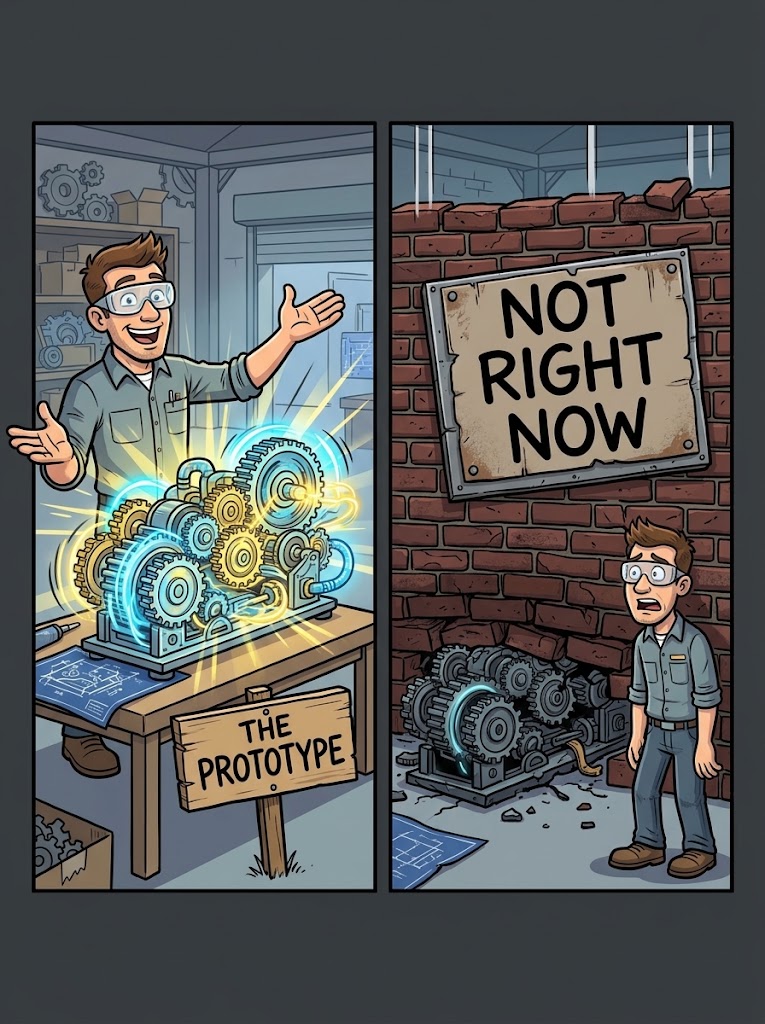
“It’s not going to happen right now,” Grant said.
Tom waited for the rest of the sentence. It didn’t come.
“Which part isn’t going to happen? The pilot? The timeline? I can move on the timeline.”
“Any of it. Not right now.”
“Is this a security concern? I built the case around the boundary specifically because I expected that question.”
“It’s not a security concern.”
“Procurement? Contract terms? Is there something in the Dynamics agreement I don’t have visibility into?”
“I don’t know what’s in the agreement,” Grant said, and Tom believed him, which somehow made it worse. “That’s not what I’m telling you.”
“Then what are you telling me?”
Grant looked at the screen a moment longer, the prototype still sitting there, patient, correct, working exactly as advertised. “Keep thinking that way,” he said. “This is good work. I mean that. But it’s not going to happen now.”
Tom had spent enough years reading Grant to know the difference between a man delivering his own decision and a man delivering someone else’s verdict without the reasoning attached to it. This was the second kind. Grant wasn’t defending Dynamics. He wasn’t defending procurement, or the contract, or any position Tom could actually argue with, because Grant didn’t have a position here at all. He had an instruction, from somewhere Tom couldn’t see, and no reason handed to him worth passing along, and Grant, being exactly the manager he’d always been, wasn’t going to manufacture one of his own just to give Tom something to push against.
“I’m not going to get a reason,” Tom said. Not a question either, by the end of it.
“Not from me. Not today.”
Wesley and Zayn were still in the room when Tom got back, the prototype still up on the shared monitor, the fourteen-minute gap still sitting there collapsed to under a second, waiting for a verdict that had already arrived and had nothing in it worth repeating.
“Well?” Wesley asked, reading Tom’s face before he’d said anything.
“Not right now,” Tom said. “That’s the whole answer. Not a no on the architecture. Not a no on the cost case. Not a security finding, not a contract issue, not a governance gate we missed. Just, not right now, and keep thinking that way.”
Nobody said anything for a while. The monitor kept doing its quiet, useless work, updating a case record in under a second for an audience of exactly nobody who was allowed to act on it.
“If there was a real reason,” Zayn said, finally, “I could argue with it. I’ve argued with real reasons before. I lost some of those arguments and I was fine with losing them, because I understood what I was arguing against.”
“There’s nothing here to argue with,” Tom said. “That’s the part I wasn’t ready for. I walked in expecting a fight. I had answers queued up for six different fights. Nobody wanted any of them.”
Wesley leaned back, arms crossed, looking at the screen like it had personally let him down by working exactly as intended. “So what do we do with it?”
Tom didn’t have an answer for that one either, and for once he didn’t try to manufacture the confidence to sound like he did.
It was Zayn who finally said the part none of them had said out loud yet, in the same unhurried voice he used for most things, a calm that had never once had anything to do with confidence and everything to do with not needing the room to notice him.
“I’ve had a version of this conversation before,” he said. “Different platform, different room, further back than either of you probably remember me from. Same two words at the end of it, more or less. I keep thinking the shape of it will surprise me eventually. It never does.”
Nobody in the room had a better way to say it than that. Tom had walked in armed for a debate about risk, and the debate never happened, because a debate requires two sides willing to say what they actually believe, and only one side had shown up willing to do that.
He thought about Priya, at the elevators, describing a customer who knew his own case history better than the system did. He thought about the invoice Grant had forwarded without comment. He thought about the specific shape of a decision made somewhere above all of them, by someone who’d never seen the fourteen-minute gap collapse to under a second, who would never have to explain that gap to a customer on a live call, and who would also never have to explain, to anyone in this room, why the thing that fixed it wasn’t going to happen.
He closed the laptop. Not dramatically. Just the ordinary motion of ending a day that had already ended somewhere else, in a different room, without any of them in it. Zayn closed his own a moment later, the same gentle, unhurried motion he used for most endings, already at peace with this one the way he’d clearly made his peace with the last.
“Same time tomorrow?” Wesley asked, half a joke, and none of them laughed, and none of them said no either.
There’s a version of this story where the villain is easy to name. A manager kills good work to protect a bad vendor relationship, or to protect his own comfort, or because he’s simply wrong, and the reader gets to feel the clean satisfaction of knowing exactly who to be angry at. That’s not this story, and it’s worth sitting with why, because the real version is more useful and considerably more common.
Grant wasn’t protecting Dynamics. He almost certainly didn’t have the full reasoning himself, which is its own kind of failure, several levels removed from anything Tom’s team could see or fix. Somewhere above Grant, a decision got made, for reasons that may have been entirely defensible, tied to a contract term, a political relationship, a timing consideration none of them were positioned to weigh. The problem was never that the decision existed. Organizations make calls their engineers don’t get full visibility into all the time, and most of the time that’s simply how scale works.
The problem was the specific shape of how it arrived: as a verdict with no reasoning attached, delivered by someone who couldn’t supply the reasoning even if he’d wanted to, praising the work in the same breath he refused it. Keep thinking that way, but it’s not going to happen now. That sentence does something a flat no never does. A flat no, with a real reason behind it, gives a team something to push against, adjust to, or accept. Praise wrapped around an unexplained refusal gives a team nothing to hold, only the unsettling sense that the effort itself was correct and the result still didn’t matter, which is a much harder thing to build a next move out of.
That’s the actual damage, and it isn’t abstract. Tom, Wesley, and Zayn didn’t walk away from that room newly convinced that hard problems are hard. They walked away newly uncertain whether solving one is even the thing this building rewards, which is a far more corrosive lesson to teach a strong engineer than any technical failure could ever be. A team that loses an architecture debate learns something about architecture. A team that wins the debate and still gets nothing learns something else entirely, and it’s not a lesson that makes the next prototype more likely to get built.
The fix isn’t heroics. It isn’t Tom building a better deck, or finding a sharper angle, or waiting for a more sympathetic ear somewhere upstream. It’s an organization deciding, deliberately, that a decision travels down with its reasoning attached, even when the reasoning is inconvenient, even when it’s we can’t explain the rest right now, but here’s as much as I can tell you and here’s who actually owns the call. Anything less than that doesn’t protect the business from a bad prototype. It just teaches the people capable of building the good ones to stop bringing them through the front door.
Field Fiction
If this one hit close to home…
This story is set in the same world as We Don’t Need Experts, a novel about what it actually costs to lead differently.